ANT BEE TRACE · FROM THE PACK BACK TO ORIGIN
- A good cup has a flavor you remember.
- A clear record lets you understand how it got there.
Coffee traceability starts with a simple question: Where did this pack come from, and when was the coffee roasted and packaged? Ant Bee Trace helps you find the answer with the QR code or lot code on the pack.
Behind each lot are a growing region, processing steps, and key production dates. An easy-to-read record helps drinkers understand their coffee and gives cafés and partners a shared reference when talking with Ant Bee.
What is Ant Bee Trace?
Ant Bee Trace connects the code on the pack with a published traceability record. Each lot code opens the record for that specific batch of coffee.
Find the right lot
Compare the lot code, product name, and dates with the information on the pack.
Know the origin
Explore the growing region and the documents linked in the record.
Understand the flavor
Read regional sensory profiles by harvest.
The level of detail varies by record. “Not published” means that particular information has yet to be shared publicly. Internal farm logs remain part of Ant Bee’s operations. Transparency includes being precise about what data is available.
Video guide to Ant Bee Trace
Watch the guide below and try it with the code on your own pack. The video shows the actual interface with Vietnamese captions and uses lot 260917-01 as an example.
55 seconds · Vietnamese captions. Press play to watch, or open full screen to read the text more clearly. The video shows the actual Ant Bee Trace interface.
Trace your coffee in three steps
Step 1. Scan the QR code or enter the lot code
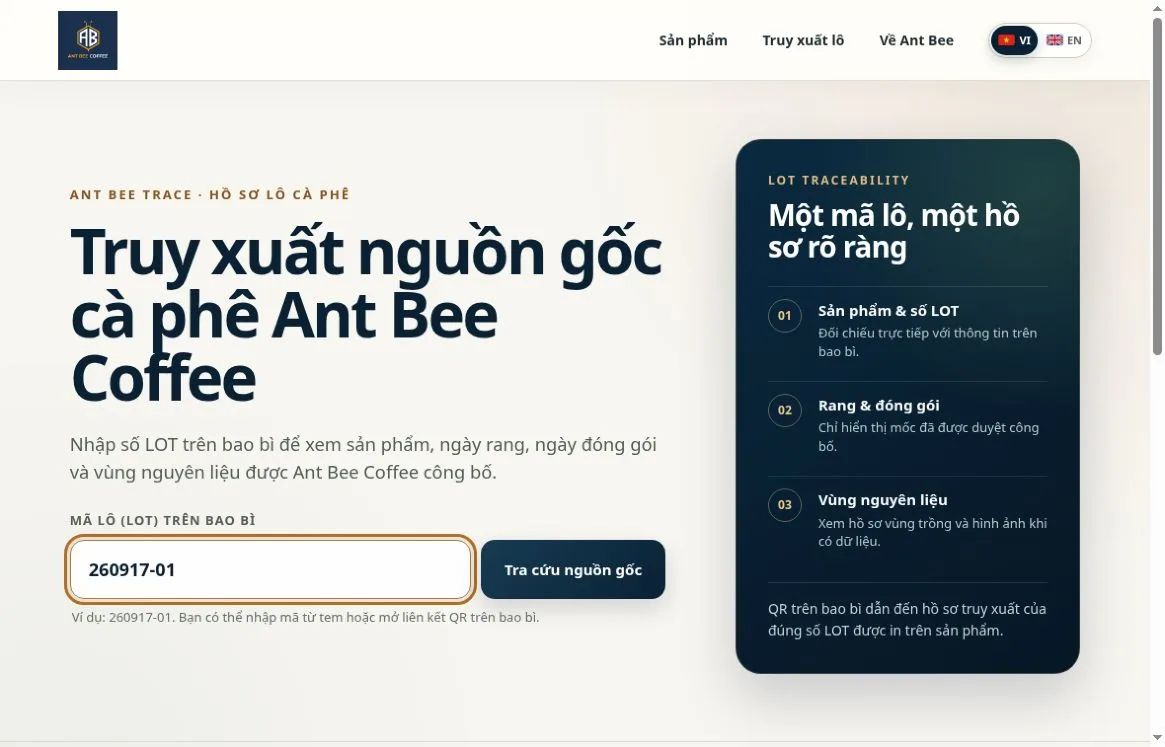
Scan the QR code on the pack with your phone to open the linked record. To look it up manually, open Ant Bee Trace, find “MÃ LÔ (LOT) TRÊN BAO BÌ” (lot code on the pack), and enter the whole code, including any hyphens.
01. Enter the lot code from the pack, then select “Tra cứu nguồn gốc” (look up origin). 260917-01 is an example.
Step 2. Compare the record with the pack
Select “Tra cứu nguồn gốc” (look up origin). When the record opens, check the lot code and product name first. Then compare the roast date, packaging date, and expiry date. These details help confirm that you are looking at the record for the coffee you are using.
If nothing comes up, check every character on the label and try again. If the information still does not match, keep the pack and the lot code so Ant Bee can help check it.
Step 3. Explore the coffee lot record
The quick links take you to lot information, the production journey, the product, the growing region, and the regional flavor profile. Start with the lot data, then explore the origin and related records.
02. Start by checking the lot code, the product name, and the production dates.
From a lot code to the story of Cầu Đất coffee
Lot 260917-01 of Cầu Đất–Đà Lạt Catimor Arabica is a practical example. Its record lists September 14, 2026 as the roast date, September 17, 2026 as the packaging date, and September 16, 2027 as the expiry date. These dates belong to the example lot. Use the code on your own pack to check another lot.
The growing-region section takes you from the pack back to where the coffee was grown. This record lists Cầu Đất, Đà Lạt, Lâm Đồng and includes a map and images approved for publication by Ant Bee. They provide a starting point for learning about the stated origin.
03. The growing region published in the lot record is Cầu Đất, Đà Lạt, Lâm Đồng.
The record also links to Ant Bee’s authorization to use the Lâm Đồng Coffee geographical indication, number LĐ-CP-004. Read the document alongside the product and the scope of the information relevant to its lot.
Flavor profiles by region and harvest
Alongside production data, Ant Bee Trace publishes cupping records so you can explore a growing region’s flavors across different harvests. Check the region name, harvest, processing method, and source of the record.
How to read sensory scores
Scores in the regional flavor profiles describe samples representative of a growing region for a given harvest. They apply to a specific finished lot only when its record publishes a direct link to the evaluation.
04. Read the score alongside the region, harvest, and sample evaluated. The displayed score is not specific to finished lot 260917-01.
Reading a record in context makes discussions about coffee more accurate and rewarding. Drinkers get more to explore, cafés get better information to share about their products, and the work of the sensory assessors is recognized.
Frequently asked questions about looking up a lot
Where can I find the lot code?
Look for it on the coffee label or sticker. Enter that code in Ant Bee Trace or scan the QR code on the pack to open the relevant link. Use the code on your product rather than the example from this guide.
Does scanning the QR code prove the product is genuine?
The QR code opens information. To check the product, also compare the lot code, name, and details on the pack and consider where you bought it. Contact Ant Bee if something is unclear.
Why are some fields marked “Not published”?
The traceability site shows information approved for publication. “Not published” means the public record does not currently share that data. It is not a certification or a statement about quality.
Get to know the coffee you choose
Flavor is something you experience in the cup. Knowing the origin makes the story behind it clearer, from the growing region to each lot. This is how Ant Bee puts transparency into practice and shares the craft and expertise behind the coffee.
Need help checking a lot code? Contact Ant Bee or explore more of our coffee guides.