
ANT BEE COFFEE · ORIGIN & IDENTITY
A cup of coffee can bring a place to mind through its aroma and lingering finish. A geographical indication gives that story a firmer footing: it identifies the origin, describes the product’s characteristics, and governs who can use the name. For Lâm Đồng coffee, it helps protect the growing region’s value and share it with the people who enjoy its coffee.
When a place name gains legal protection
Cầu Đất, Đà Lạt, and the coffee-growing areas of Lâm Hà are familiar names to coffee drinkers. People increasingly want to know what a place name on the pack tells them: Where were the beans grown? What gives the region its character? How can they check the information?
A geographical indication, or GI, centers on the relationship between a product and where it is made. As the World Intellectual Property Organization (WIPO) explains, a product bearing a GI comes from a particular place and has a quality, reputation, or characteristic linked to that origin. The name draws its value both from the region and from the requirements its users must meet.
On October 10, 2025, the Intellectual Property Office of Vietnam issued Decision No. 636/QĐ-SHTT, granting Geographical Indication Registration Certificate No. 00147 for Lâm Đồng coffee. It covers Arabica and Robusta in three forms: green beans, roasted beans, and ground coffee.
The registration is a milestone for growers, processors, and coffee drinkers. The Lâm Đồng name now has a formal framework of protection, helping recognize and preserve the value built over many harvests.
Identity begins with the land, climate, and people who make the coffee
Elevation, climate, and soil are the natural foundations of Lâm Đồng coffee. Local publications describe how cool conditions at higher elevations allow cherries to ripen more slowly, while soil characteristics also help shape the beans. Farm management, harvesting, processing, and storage further affect the quality of the green coffee.
Flavor is shaped at every stage. A lot needs careful harvesting and processing, the roaster needs to understand the beans, and the brewer needs to choose a suitable extraction method. Sensory studies presented by the Specialty Coffee Association also show that roast level and brewing conditions affect how flavors come through. The name of the growing region is a useful starting point for understanding the coffee.
In the characteristics published by the Intellectual Property Office, Lâm Đồng Arabica is described with notes of apricot, peach, citrus, almond, brown sugar, and chocolate. Robusta is described with fruit, light chocolate, flowers, sugarcane, and caramel. These notes give drinkers more ways to explore the region’s coffee.
Read a flavor profile as a sensory description. Notes of fruit or chocolate describe what tasters perceive in the cup. Each variety, harvest, processing method, and roast level can express itself differently. Start with familiar sensations such as the brightness of the acidity, sweetness, body, and the clarity of the finish.
Who manages and checks the Lâm Đồng Coffee geographical indication?
Understanding a GI starts with knowing which authorities establish the rights, manage the registration, and check how it is used.
The Intellectual Property Office, part of the Ministry of Science and Technology, issues the decision granting a GI registration certificate. According to its announcement, the Lâm Đồng Department of Agriculture and Environment manages this geographical indication.
At the local level, the 2026 inspection records provided to businesses identify the Lâm Đồng Crop Production and Plant Protection Subdepartment as the contact for scheduling and preparing records. A compliance team checks whether users meet the conditions for using the geographical indication.
Checks cover growing areas, production and processing logs, purchase contracts, traceability records, quality assessments, and the management of logos and labels. Site visits to farms, processing facilities, and warehouses connect the records with day-to-day operations.
The Lâm Đồng Department of Science and Technology also works on establishing, managing, and developing geographical indications through scientific projects. In December 2025, the province announced its review and acceptance of that work. The Department of Agriculture and Environment has the separate role of managing the GI itself.
For consumers, the practical benefit is being able to verify that a protected name is supported by the relevant growing area, product, and records. Read a company’s authorization alongside the scope and conditions applicable to the specific product.
Ant Bee Coffee’s authorization to use the Lâm Đồng Coffee geographical indication
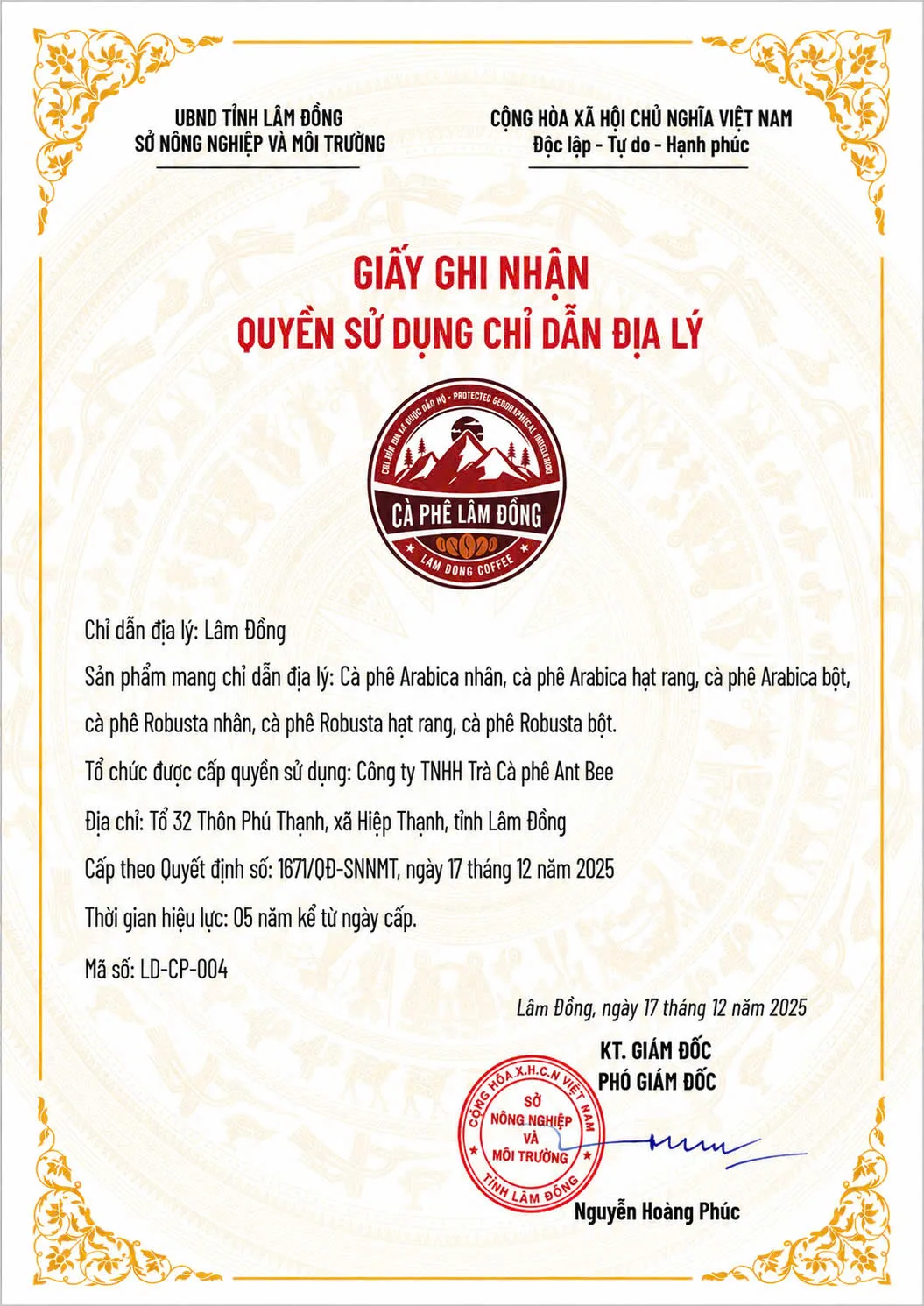
The Lâm Đồng Department of Agriculture and Environment granted Ant Bee Tea and Coffee Co., Ltd. authorization under Decision No. 1671/QĐ-SNNMT of December 17, 2025. The authorization is numbered LĐ-CP-004 and is valid for five years from the issue date shown on the document.
Ant Bee’s authorization lists six product forms: green Arabica, roasted Arabica, ground Arabica, green Robusta, roasted Robusta, and ground Robusta. The public copy is available in the documents section of Ant Bee Trace, where you can check the organization name, reference number, and issue date.
Ant Bee Coffee connects geographical indication information to the relevant product and lot records. The authorization applies in relation to the origin of the beans and the conditions for each product. Blends from several regions need to be labeled with their actual composition and origins. The brand name alone cannot extend the GI to the entire range.
Stating the scope clearly helps customers understand exactly what they are choosing. It also respects the land and the people who built the reputation of Lâm Đồng coffee.
Fine Robusta, specialty coffee, and geographical indications
When choosing Fine Robusta or specialty coffee, drinkers often care about both cup quality and origin. The two types of information complement each other. A geographical indication identifies how a product is linked to the protected region, while a cupping record describes and evaluates a sample under specific conditions.
A score needs to be read alongside the sample name, harvest, processing method, and assessor. A GI establishes origin rather than a cupping score or competition result. A good sensory result also needs supporting origin records if the product carries a protected name.
For a café or home brewing, start with the origin, then check the flavor profile and roast before choosing a coffee that suits your method. Phin, espresso, and filter brewing can bring out different aspects of the same coffee.
From the authorization to individual lot records on Ant Bee Trace
Coffee traceability makes it easier to access growing and production information. Enter the lot code on the pack in Ant Bee Trace to open the record and view the data Ant Bee has approved for publication.
For example, the record for lot 260917-01 of Cầu Đất–Đà Lạt Catimor Arabica lists 100% Cầu Đất, Đà Lạt, Lâm Đồng origin, a roast date of September 14, 2026, a packaging date of September 17, 2026, and links to the associated roast batch and green coffee lot. It also links to geographical indication authorization LĐ-CP-004.
The example shows how information on the pack can be checked against production records. Enter the code from your own pack and compare the product name, roast date, packaging date, and origin. The data belongs to the record you open, so look up each lot individually.
The regional flavor profiles on Trace also let you explore samples evaluated by harvest. These scores describe samples representative of a growing region in a particular harvest. They apply to an individual finished lot only when its record publishes a direct link to that evaluation.
Read our Ant Bee Trace guide to get familiar with the process, or open the lookup and enter the lot code on your pack. A general understanding of the region can then be backed up with details about the coffee you are choosing.
Protecting the value of a region with records you can verify
Lâm Đồng coffee is rewarding both for what you taste and for what you learn about where it began. The geographical indication protects the name, producers preserve quality through their daily work, and traceability records make that story easier to follow.
When you choose an Ant Bee Coffee product, take a minute to read the origin, check the lot code, and open the related documents. The flavor is yours to discover. The origin, production dates, and scope of the claims on the pack are all things you can look up. It is a way to enjoy coffee with a deeper understanding of the place that produced it.
- Get to know your coffee
- Look up your lot code on Ant Bee Trace · Read the traceability guide
Information checked on October 3, 2026 against announcements from the Intellectual Property Office, local records, and Ant Bee’s public documents. Read the scope of the authorization alongside the relevant product and records.